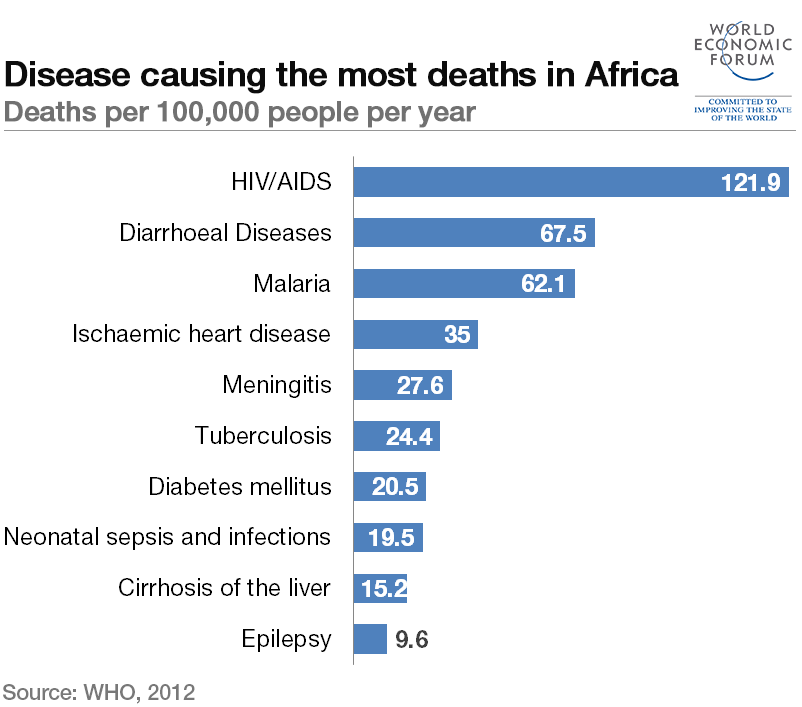
Deaths in Africa in 2012 fell largely in the WHO Group 1 category (death through communicable diseases, and perinatal, maternal and nutritional causes): 5.9-million deaths amounting to 61.7% of all deaths in sub-Saharan Africa.Group 2, death as a result of non-communicable diseases, accounted for 2.7-million deaths or 28.6% of all deaths. This category includes heart disease (293,000 deaths), various forms of cancer (426,000) and diabetes (175,000). Group 3, deaths through injury, amounted to 939,000 deaths, or 9.8% of the total. Group 3 causes of death include unintentional injuries, such as road accidents (207,000), and intentional injuries, such as inter-personal violence (132,000) and collective violence (14,000). Non-communicable and lifestyle diseases are the top killers in high-income countries, accounting for 67.8% of deaths in 2012. In contrast, many of the top killers in sub-Saharan Africa – lower respiratory tract infections, tuberculosis, diarrhoeal disease and malaria – are preventable and treatable, given adequate healthcare systems and resources.HIV/Aids is the biggest killer in Africa by a large margin, with 122 deaths per 100,000 people in 2012. This is nearly double the deaths from diarrhoeal diseases, which caused the second-largest number of deaths.While overall communicable diseases account for the majority of deaths, a number of non-communicable diseases feature on the list – including ischaemic heart disease (hardening of the arteries) in fourth place, diabetes in seventh and cirrhosis of the liver in ninth. Most of the diseases can be prevented by higiene and education and most of theses diseases affect women and childre. Some of these diseases are syphilis, meningitis,tetanus, whooping cough and measles source https://africacheck.org/factsheets/factsheet-the-leading-causes-of-death-in-africa
Poverty is the principal cause of hunger in Africa and elsewhere. Simply put, people do not have sufficient income to purchase enough food. As noted above, in 2012, 47 percent of the population of sub-Saharan Africa lived on $1.90 a day or less, a principal factor in causing widespread hunger. A related topic is corruption. Freedom in the World is an annual index that measures the degree that people have political rights and civil liberties. See its (mainly low) freedom rankings for sub-Saharan African countries in 2016 at http://www.freedomhouse.org/report-types/freedom-world. One way that those in positions of power obtain income is through corruption. The 2015 map of perceived corruption worldwide done by Transparency International shows that many sub-Saharan African nations are viewed as having a serious problem with corruption.
Conflict is a principal source of human misery, including poverty and hunger. According to a World Bank study, —poverty rates are 20 percentage points higher in countries affected by repeated cycles of violence over the last three decades; —Every year of violence in a country is associated with lagging poverty reduction of nearly one percentage point; —People living in countries currently affected by violence are twice as likely to be undernourished and 50 percent more likely to be impoverished. Their children are three times as likely to be out of school; —Countries with serious human rights abuses or weak government effectiveness, rule of law, and control of corruption have a 30 – 45 percent higher risk of civil war, and significantly higher risk of extreme criminal violence than other developing countries (World Bank 2011b) http://www.worldhunger.org/africa-hunger-poverty-facts Source:
The health effects caused by shifts in malaria transmission rates in the African Highlands have the potential to be severe. Research has shown that the effects of climate change on health will impact most populations over the next few decades.[12] However, Africa, and specifically the African Highlands, are susceptible to being particularly negatively affected. In 2010, 91% of the global burden due to malaria deaths occurred in Africa. Several spatiotemporal models have been studied to assess the potential effect of projected climate scenarios on malaria transmission in Africa. A study conducted by Caminade et al.[13] concluded that the most significant climate change effects are confined to specific regions, including the African Highlands. These results are consistent with previous studies.Ultimately, studies show an overall increase in climate suitability for malaria transmission resulting in an increase in the population at risk of contracting the disease.[13] Of significant importance is the increase of epidemic potential at higher altitudes (like the African Highlands). Rising temperatures in these areas have the potential to change normally non-malarial areas to areas with seasonal epidemics.[14] Consequently, new populations will be exposed to the disease resulting in healthy years lost. In addition, the disease burden may be more detrimental to areas that lack the ability and resources to effectively respond to such challenges and stresses.https://en.wikipedia.org/wiki/Climate_change_in_Africa